Anavar Hair Loss: Does Anavar Thin Your Hair, Who Is at Risk and What Helps
The "Hair-Safe Steroid" Reputation Is Only Half True
Anavar hair loss is one of the most argued topics in oxandrolone threads, because the compound has a reputation as the hair-safe oral and that reputation is only partly earned. Oxandrolone is less androgenic than almost every alternative, an androgenic rating around 24 against testosterone's 100, but it is still a DHT derivative, and in men and women whose follicles are genetically sensitive to androgens it can accelerate thinning that was already programmed.
This guide explains the mechanism, who is actually at risk, what the community data shows about prevalence and dose, how oxandrolone compares with other compounds, which prevention strategies have evidence behind them, and how to tell temporary shedding from permanent loss. It sits alongside the Anavar side effects in women guide, which covers the female-specific picture, and the Anavar cycle guide, which sets the dose and length that keep follicular exposure low.
If there is no genetic predisposition to pattern baldness, Anavar will not cause hair loss. It accelerates a process the follicles are already primed for; it does not start one.
Does Anavar Cause Hair Loss? The DHT Mechanism
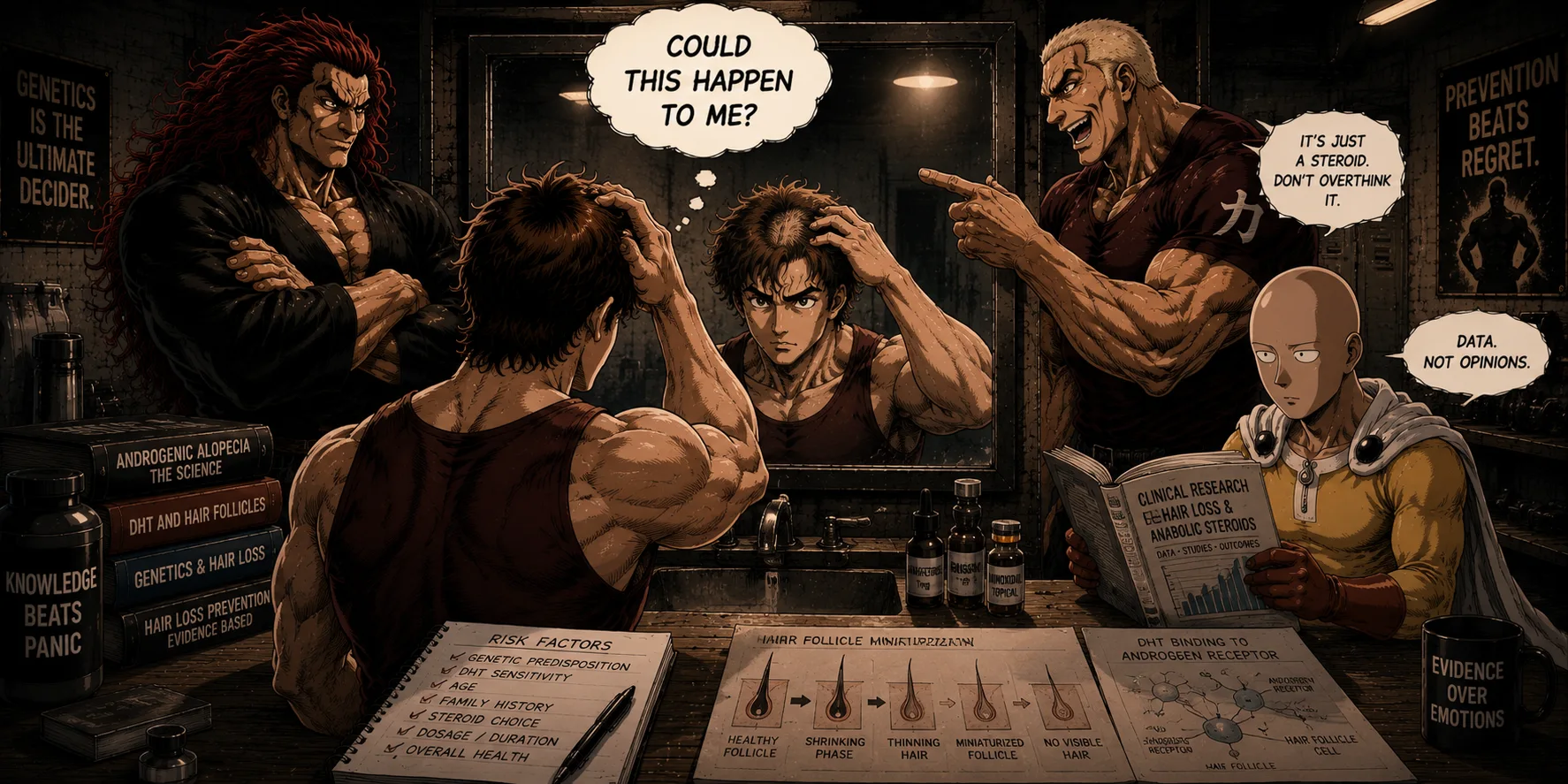
Does Anavar cause hair loss at all? In predisposed users, yes, and the reason is structural. Dihydrotestosterone is the androgen responsible for follicle miniaturisation, the progressive shrinking of terminal follicles into thinner, shorter hairs until they stop producing visible hair. That process only happens in follicles that carry androgen-receptor sensitivity, which is genetic. Hair is one item on a longer list; the rest is covered in the Anavar side effects guide.
Testosterone has to be converted into DHT by the enzyme 5-alpha reductase before it can act on those follicles. Oxandrolone does not. It is already a DHT derivative, structurally close enough to bind the androgen receptor in the follicle directly without any enzymatic step. That difference matters for prevention: finasteride and dutasteride block the conversion pathway, and Anavar does not use it.
The other thing the mechanism explains is why blood work looks reassuring while the pillow says otherwise. Oxandrolone does not raise serum DHT, on cycle, DHT is usually unchanged or slightly lower because natural testosterone is suppressed. The follicular effect is direct receptor activation at the scalp, not systemic DHT elevation, so a normal DHT reading on a blood panel says nothing about what the follicles are experiencing.
Who Is Actually at Risk
Anavar hair loss risk is decided almost entirely by genetics. The androgen receptor gene sits on the X chromosome, which makes the maternal line the stronger predictor, though either side counts.
The high-risk profile: a father or maternal grandfather with significant thinning or baldness; thinning, recession or increased shedding already noticed in the twenties or thirties; a Norwood 2 or higher pattern already visible at the temples; and any previous steroid cycle that produced shedding. The low-risk profile: no family history on either side, full and thick hair past thirty with no miniaturisation, thick density across crown and temples, and previous cycles with zero hair change.
The community's shorthand rule is that if oxandrolone is going to affect the hair, the user will know by week three. Reaching week four with no increase in shedding is a reasonable sign that the follicles are not sensitive enough for the compound to matter at that dose.
Does Anavar Thin Your Hair? What the Data Shows
No controlled study has measured Anavar hair loss rates, so the numbers come from thousands of community reports, and they are consistent. Roughly 50 to 60% of users report no hair impact at all. Around 20 to 25% report mild increased shedding that is temporary and recovers after the cycle. Some 10 to 15% report noticeable thinning that partially recovers. And 5 to 10% report significant acceleration of existing pattern baldness.
Dose shapes the Anavar hair loss distribution. At 20 to 40 mg daily, even predisposed users report minimal impact. At 50 to 60 mg, moderate shedding appears in a share of predisposed users. At 80 to 100 mg, reports of significant shedding in that group rise sharply. Duration compounds it: a six-week cycle produces measurably less cumulative follicular exposure than eight weeks, and back-to-back oral cycles with short breaks are where the long-term thinning stories come from. Women follow the same pattern at their doses: scalp thinning in roughly 10 to 15% of female users, usually diffuse rather than patterned, and typically reversible within three to six months.
Community-reported hair impact by dose (predisposed men)
20 to 40 mg
Minimal, even in predisposed users
Low
50 to 60 mg
Moderate shedding in a share of predisposed users
Moderate
80 to 100 mg
Significant shedding reported regularly
High
The dose-response for hair loss is steeper than the dose-response for muscle. A user moving from 40 to 80 mg gives up far more hair per milligram than he gains in tissue, which is the single strongest argument for staying in the 30 to 40 mg range if hair matters.
Anavar vs Other Steroids for Hair
Hair loss risk by compound
Testosterone
Moderate
Converts to DHT via 5-alpha reductase
Anavar (oxandrolone)
Low, moderate
Direct DHT derivative, mild androgenic rating
Winstrol
Moderate, high
DHT derivative, higher androgenic activity
Masteron
High
Pure DHT derivative, strong receptor binding
Trenbolone
High
Extreme androgenic activity
Primobolan
Low, moderate
DHT derivative but very mild
Turinabol
Low
Not DHT-derived, no conversion
Nandrolone (Deca)
Very low
Converts to DHN, weaker than DHT at the follicle
Oxandrolone sits in the lower-middle of the range: clearly gentler than Winstrol, Masteron or trenbolone, not as hair-safe as turinabol or nandrolone. For a user who wants an oral cutting compound and cares about hair, it is the best DHT-derivative option available, and the Turinabol vs Anavar comparison is the one to read if hair is the deciding factor, because turinabol wins on that axis. The Anavar vs Winstrol comparison covers why Winstrol is the worse choice for the same reason.
Prevention: What Works and What Does Not
Finasteride and dutasteride have limited direct value. They block 5-alpha reductase, and oxandrolone bypasses it, so they do nothing about Anavar's own action at the follicle. They do have indirect value for a user on a testosterone base: 1 mg of finasteride daily cuts serum DHT by about 65% within 24 hours, according to the Propecia label, which lowers the total androgenic load on the scalp. The net result on a test-plus-Anavar cycle is partial protection; on an Anavar-only cycle it is close to none. The Anavar and test cycle guide notes where finasteride fits in that structure.
Topical anti-androgens are more targeted. RU58841 is a topical androgen-receptor antagonist applied once daily to thinning areas that blocks androgen binding at the follicle regardless of the compound's source; community reports suggest meaningful protection during cycles, but it is a research chemical with no FDA approval and limited long-term safety data. Ketoconazole 2% shampoo has a mild anti-androgenic effect at the scalp, is used three to four times a week left on for three to five minutes, and is safe long term, modest protection, not enough alone for aggressive shedding. Minoxidil 5% does not block androgens at all; it supports follicle health through blood flow, helps maintain hair during a cycle, and must be continued or the hair it kept is lost.
The most reliable Anavar hair loss prevention is the boring one: dose and duration. Prevention that actually moves the numbers:
- 1Run 30 to 40 mg rather than 60 to 80 mg; the hair cost per milligram rises faster than the muscle gain
- 2Keep cycles at six weeks rather than eight if predisposed; exposure is cumulative
- 3Leave at least three to four months between cycles so follicles partially recover
- 4Add ketoconazole shampoo from day one and minoxidil if any shedding starts
- 5Use finasteride only when there is a testosterone base for it to act on
"There's no such thing as a shortcut. Every day of training is a day of training. The rest is excuses.", Saitama
For hair, the shortcut is the higher dose and the longer cycle, and the excuse is that the follicles will cope. Predisposed users who kept their hair are, almost without exception, the ones who ran low and short.
Shedding vs Permanent Loss: Telling Them Apart
Not all hair lost during a cycle is gone for good, and the two patterns look different. Temporary shedding, telogen effluvium, is triggered by the hormonal shift of starting or stopping a steroid, which pushes hairs into the shedding phase early. It is diffuse across the whole scalp rather than patterned, usually starts two to four weeks into the cycle or two to four weeks after stopping, resolves within three to six months as follicles re-enter the growth phase, and the replacement hairs are as thick as the originals.
Androgenic alopecia acceleration is different. It is pattern-specific, temples, crown and frontal hairline thin while the sides and back stay thick, the follicles are miniaturised so replacement hairs are finer and shorter, it does not fully reverse after stopping although progression halts once the androgenic stimulus is removed, and it is cumulative across cycles. A user shedding 100-plus hairs a day diffusely who recovers fully three months later had telogen effluvium. A user whose temples visibly receded and whose regrowth is finer had pattern loss that oxandrolone accelerated.
What to Do If Shedding Starts, and Recovery
The response scales with severity. For mild shedding, a little more hair on the pillow or in the drain, diffuse, continue the cycle, add ketoconazole shampoo two to three times a week, photograph the scalp weekly in the same light because subjective assessment is unreliable, and watch for it to stabilise, which it usually does. For moderate shedding, clearly more than normal, thinning visible, cut the dose by half, add minoxidil 5% twice daily to the affected areas, and if the shedding continues for two more weeks at the reduced dose, stop; do not return to the original dose in future cycles. For severe shedding, rapid visible thinning, hairline moving, stop oxandrolone immediately, keep any testosterone base at a replacement dose to avoid a hormonal crash, start minoxidil, see a dermatologist who specialises in hair, and build future cycles around non-DHT compounds such as turinabol or nandrolone.
Recovery from temporary shedding follows a predictable arc: shedding stops within two to four weeks of discontinuation, new growth enters the anagen phase within one to two months, and density returns over four to eight months, with biotin, zinc and iron (if deficient) as reasonable nutritional support. Recovery from accelerated pattern loss is partial: progression stops, minoxidil and, with a testosterone base, finasteride can regrow some hair, but follicles that miniaturised rarely return fully, and keeping the regrowth means keeping the minoxidil. The broader picture of what oxandrolone does to the body is on the side effects page.
Frequently Asked Questions
No. Roughly half to 60% of users report no hair change at all. Oxandrolone accelerates thinning only in people whose follicles are genetically sensitive to androgens, typically those with a family history of pattern baldness or existing recession. Without that predisposition, the compound has nothing to accelerate.
Rarely. At 20 to 40 mg daily, even predisposed users report minimal impact, and the community rule is that any effect is obvious by week three. Shedding reports rise at 50 to 60 mg and become common at 80 mg and above, which is why users who care about hair stay at the low end.
Two patterns occur. Diffuse shedding from the hormonal shift is temporary and regrows fully within three to six months. Accelerated pattern loss at the temples and crown does not fully reverse, although it stops progressing once the compound is stopped. Dose, cycle length and genetics decide which one a user gets.
Only partially, and only when there is a testosterone base. Finasteride blocks the conversion of testosterone to DHT, but oxandrolone is already a DHT derivative and skips that step, so finasteride does not block its direct action at the follicle. Topical options such as ketoconazole shampoo and RU58841 address the follicle itself.
Usually not. Oxandrolone's androgenic rating is about a quarter of testosterone's and many users report less shedding on it than on testosterone alone. The caveat is that finasteride, which protects well against testosterone-derived DHT, protects poorly against Anavar, so a user relying on finasteride may find Anavar the harder compound to manage.
If the loss was diffuse shedding, yes, it stops within two to four weeks of stopping and density returns over four to eight months. If it was pattern loss that the compound accelerated, regrowth is partial at best: minoxidil can recover some density, but miniaturised follicles rarely return to their original state.
This article is for educational and harm-reduction purposes only and is not medical advice. Oxandrolone is a prescription-only or controlled substance in most countries; anyone considering it should consult a licensed physician.
Anavar.org is an independent educational resource. We are not affiliated with any pharmaceutical manufacturer or healthcare provider. This content is for informational purposes only and does not constitute medical advice. Images on this site are illustrative artwork made for editorial purposes; they do not show real products, packaging or labels and are not an advertisement or an offer to sell.
Ryan Caldwell
Author
Comments (0)
Be the first to comment on this article.